
Children's songs are among the most obvious applications of AI music. The lyrics and musical style are usually kept simple—much like many traditional children's songs. That is precisely why they are well-suited for experiments in the classroom.
The Assignment
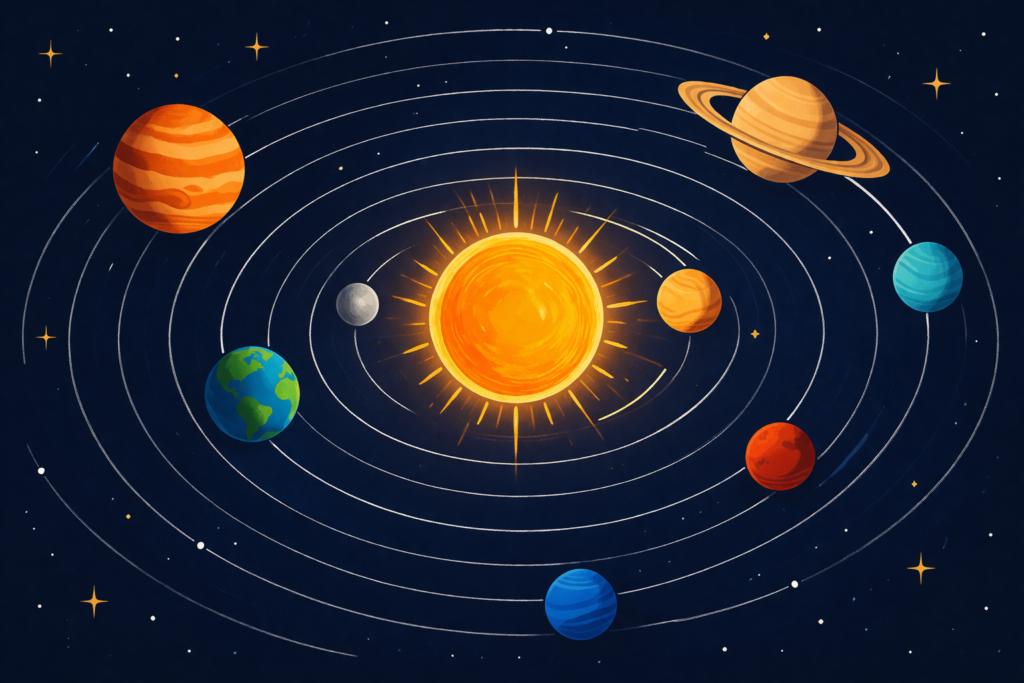
My daughter—who is a elementary school teacher herself—wanted to try out an AI song with her class. Her assignment for me: to use the Suno app to create a children’s song based on the mnemonic: “Every Sunday, my father explains the night sky to me.”
From a Mnemonic to an AI Song
First, I gathered material online related to the saying that describes the arrangement of the planets, which was then processed into song lyrics with the help of AI. But that alone doesn’t make for good lyrics. The next step was to further refine the text—especially where the rhymes came across as a bit too trite. And you also have to check whether the facts are correct. As is well known, AI tends to hallucinate—it could even invent “fake” planets.
Implementing this in the classroom is also challenging: Unlike pre-made songs that are already available, the use of AI opens up new possibilities that are what make this new medium so appealing in the first place—because you can tailor such a self-produced song very precisely to the situation of a school class and your own students—even to the point of “incorporating” individual children in a more specific way. And you can also highlight specific points related to a topic that you want to emphasize: introducing the topic, reviewing its key aspects, exploring related concepts, and reinforcing the central points.
Why AI Music Can Be Helpful
Much of what the following excerpt from “LMVZ digital” highlights also applies to AI music: Researchers and practitioners “emphasize the positive impact of music on development, social skills, and motivation.” They also point out that music affects different areas of the brain: memory, motor skills, spatial and visual perception are activated by music, and cognitive structures are altered. Music and movement thus have an impact on both the emotional and cognitive levels: they foster a positive overall mood and activate areas of the brain that are relevant to memory and learning processes. And, of course, the two are interconnected.”
This, too, strongly indicates that it’s not simply a matter of singing a “cute children’s song,” but rather about the added value it brings to the lesson. Motor skills, clapping, and alternating between solo and choral singing can also contribute significantly to success. However, music shouldn’t simply distract from the actual school curriculum; rather, it should incorporate it and, through the emotions it evokes, bring a new and different quality to learning. Or as Franziska Schaub puts it in the aforementioned article from LMVZ digital: “Anyone who wants to use music and movement in an interdisciplinary way in the classroom should enjoy it themselves and know their class well. You have to sense what is needed at the moment and what the children and teenagers are ready to take on. It’s important to adapt the activities to the mood, situation, and class—should they have a stimulating, lighthearted, or relaxing effect?”
And, of course, one could incorporate additional steps into a teaching plan—namely, having students compose and record their own songs; but more on that in a later chat post.
The song inspired by the planets has been uploaded here:

Write a comment