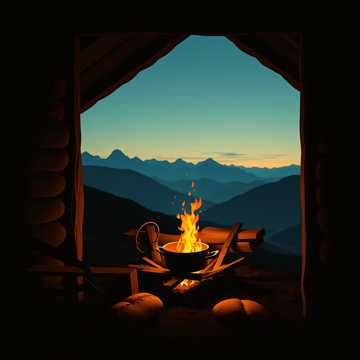

A song in Swiss German dialect—and in English, too? Can that really work? That was the question we asked the AI.
To test this out, I used Google’s Gemini to generate lyrics in the style of a Swiss German dialect song. I was curious to see if the AI could express itself in “Züritütsch.” At the same time, the assignment also called for writing the lyrics in English—as a sort of Swiss country song.
So I asked the AI: “Can you write me a Swiss pop song using the following terms: Müntschi (kiss), yodeling, sunset, fondue, Fendant?” That was all we entered, and we received the following lyrics in return:
Lyrics (Swiss German)
(Intro: Accordion and soft guitar)
Verse 1
The sun sinks behind the peaks, glowing gold and red
I'm sitting in front of the cabin; there's no need to worry
The fire is burning in the stove, the beaters are ready
That moment is all that matters in life
Chorus
An evening withfondueand a goodFendant
Love in my heart and a mug in my hand
I'd give you akiss—the world would stop for a moment
Look how thesunsetfades away in the sky
And up in the mountains, you can hear peopleyodeling a bit
Holladi-o, let my soul wander a little
Verse 2
The violin plays, the guitar keeps the beat
We just put yesterday's worries behind us
The air is so cold, but my heart is so warm
I'm holding you tight in my arms
Chorus
An evening withfondueand a goodFendant
Love in my heart and a mug in my hand
I'd give you akiss—the world would stop for a moment
Look how thesunsetfades away in the sky
And up in the mountains, you can hear peopleyodeling a bit
(Bridge: Yodel section with accordion solo)
Holladi-o-u-diiiii, ho-u-dii-o!

And right after that came an equally polished text in English.
At first glance, this result seemed absolutely incredible to us—to produce a text from just six words that makes sense, mostly rhymes, and is even written in Swiss dialect (as well as in English). If you take a closer look, however, a few inconsistencies become apparent. What exactly is a “Chacheli” in the context of fondue, and what are sausages (“Chlöpfer”) doing there? Also, the phrase “Holladi-o, wir lassen die Seele bummeln” doesn’t quite fit into a text written in Swiss dialect; and saying that one has “igepackt” one’s worries isn’t entirely grammatically correct either (the English text had it easier in that regard; but even there, one could find a few things to criticize if one looked closely). At least the word “Müntschi” (kiss) was used correctly there as well.
Nevertheless, the question arises as to how such a well-rounded result came about overall. The easiest thing to do was to ask “Gemini” directly. The bot’s response addressed two levels:
"1. The Architecture of Probabilities"
At its core, I actually operate based on probabilities. When I write the word “Sunne” (sun), there is a very high statistical probability that, in the context of a Swiss Alpine scenario, words like “peak,” “red,” “golden,” or “hut” will follow. I don’t choose the “next best” word, but rather the one that seems most fitting given the emotional tone of the context.
2. Cultural Scripts and Stereotypes
I draw on a vast amount of material that has taught me how “Swiss coziness” (Gemütli) works.
- Vocabulary:Terms like “Chlöpfer” (cervelat) or “Chacheli” (bowl/container) serve as strong anchor points. They immediately conjure up an image that goes beyond the purely linguistic.
- Mood: “The melancholy of a sunset combined with the down-to-earth nature of a fire is a classic motif of dialect songwriters (think of Mani Matter or Patent Ochsner).” (Retrieved on February 20, 2026).
But this also means that the focus is not on less creative and unusual texts, but rather on those that convey clichés and established cultural codes. The LLM databases therefore already contain vast amounts of textual fragments that are pulled out as building blocks—such as passages like: “The air is so cold, but the heart is so warm; I’ll hold you tight in my arms.” Ultimately, this results in the recombination of familiar elements rather than the creation of something radically new.
If you want more, as a “creator,” you’ll have to stick to the text yourself and edit it in the direction you want.
Next, the text had to be produced as a piece of music. To do this, we used Suno—one of the hottest music production programs right now. Gemini even had a perfectly suited music style ready for this:“Style for Suno:Swiss folk-pop, accordion, violin, acoustic guitar, upbeat but warm, male/female vocals.”
This resulted in the two songs (one in English and the other in German), which can be downloaded here. What stands out, on the one hand, is the sheer professionalism of the production: it isn’t all that different from the real pop hits you hear from “real” musicians. Some aspects may still be a bit rough around the edges, like a reverberating echo that lingers. But the software is making huge strides in a short time, so these flaws will quickly diminish. And of course, the Swiss dialect poses a challenge, as it breaks down into even smaller regional dialects. So you might hear the occasional wrong note—even if “Fondue” and “Fendant” come across as spoken in very standard German.
Overall, though, the result is amazing, and it was fun to develop this kind of slightly kitschy Alpine pop. I’ll be sharing with you, the readers of this blog, how the experiment continues—though not on the folk music wave anymore. My first attempts on YouTube will provide plenty of food for discussion here.
"Müntschi in the Mountains" (Audio: German and English)